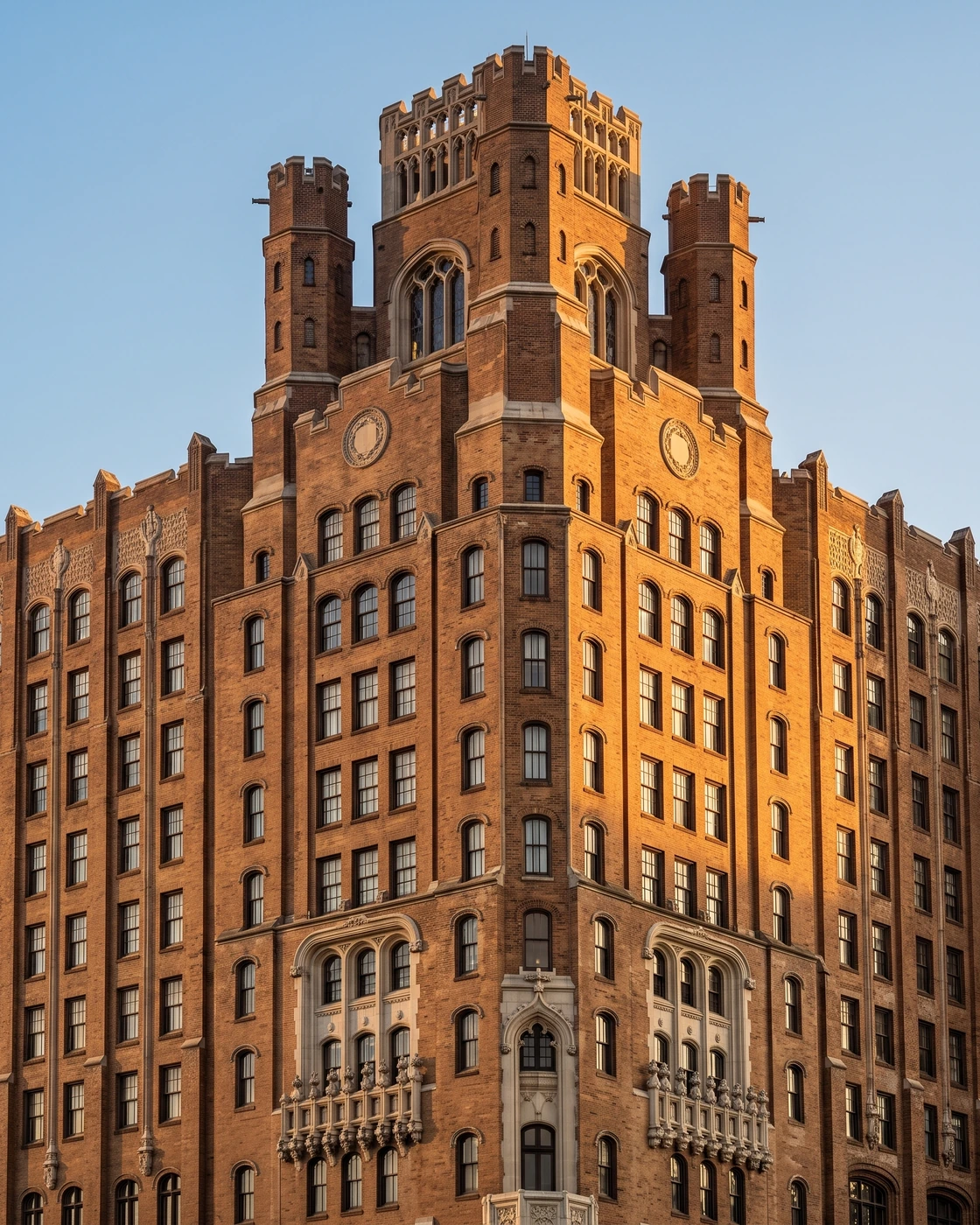
A 1933 Gothic landmark with grand ballrooms and thirty-five-foot ceilings, a few blocks from University Circle's museums.

The Tudor Arms opened in 1933 as a private club, all carved stone and Gothic brick, and it still reads that way. Today it is a DoubleTree, but the bones are landmarked: the tall tower, the leaded windows, the grand ballroom with its coffered ceiling and gilded plaster.
Most photographers shoot a hotel ballroom flat. They light the room evenly, kill the shadows, and hand you a gallery that could have been shot anywhere with a chandelier.
The Tudor Arms is not anywhere. The architecture is the frame: the vaulted ceiling, the ornamental plaster, the warm amber of the sconces against the dark wood. The job is to let that room set the tone and expose for its warmth, not against it.
Twenty years of shooting inside grand rooms taught me to read that light before the first dance.
The coffered ceiling, the ornamental plaster, the sconce light. A room that photographs like a film set when you expose for its warmth rather than flooding it with flash.
Arched stone, dark millwork, and warm pools of light. The first-look and cocktail-hour room, where the architecture does the styling for you.
The carved Gothic brick facade and the Cornell Road corner. Golden hour rakes across the stone. The exterior portrait that says University Circle without a caption.
The suites upstairs catch clean morning light through the tall windows. Detail shots, the dress on the door, the quiet before the room fills.
The ballroom lives on tungsten and sconce light. The temptation is to correct it to neutral. Do not. The room is amber by design, and the best frames keep it that way.
At thirty-five feet, the ceiling is half the photograph. A wide lens and a willingness to give it the top third of the frame is what separates a Tudor Arms gallery from a generic ballroom set.
The Gothic tower is the exterior frame, and it faces the afternoon sun. Twenty minutes before sunset the brick glows. Build that portrait window into the timeline.
The hotel sits blocks from Severance, the CMA and the Botanical Garden. A Day After session that walks between them is one of the best editorial routes in the city.
The ballroom is amber by design. Most photographers fight that. I shoot with it, and the gallery looks like the room actually felt.Reference frames · The Tudor Arms Hotel · 2026

One. The ballroom is warm-lit by design. I meter for that warmth instead of flashing it flat, so the gallery matches how the room actually felt.
Two. The thirty-five-foot ceiling wants a wide lens and the top third of the frame. I plan the reception-wide angles before the room fills with guests.
Three. The Gothic tower faces the afternoon sun. The exterior portrait is best about twenty minutes before sunset off the Cornell Road corner.
Four. The hotel is an active DoubleTree. Wedding blocks are coordinated with the events team; I confirm room access and timing a few weeks ahead.
Five. University Circle's museums are a short walk. A Day After editorial that moves between the Tudor Arms and Severance or the CMA is a signature route.
Send me your date. I'll walk the ballroom light, the tower portrait window, and the University Circle routes with you. Editorial coverage starts at $1,600 and scales to The Heirloom at $5,600, which includes a Day After editorial session.
Inquire About Your DateVisit the venue: tudorarmsevents.com